How Your Nervous System Shapes Your Executive Thoughts, Emotions, and Behaviors
Your life is not shaped by your thoughts alone. It is shaped by the state of your nervous system.
Most people walk through life believing that if they just think better, they will feel better. If they just have more discipline, more willpower, more positive thinking — everything will change. But what nobody told you is that before a single thought is formed, before a single decision is made, your nervous system has already responded. It has already assessed the situation, decided whether you are safe, and sent instructions to your entire body on how to react.
Your nervous system is the real CEO of your life. And most people have never been introduced to it.
So What Exactly Is Your Nervous System?
In the simplest terms, your nervous system is your body's command-and-communication system. It is made up of three parts:

Your brain is the CEO. It processes information, makes decisions, and runs the entire operation. Your spinal cord is the operations manager. It sits between the brain and the rest of the body, passing messages up and down, and is capable of making rapid automatic decisions without waiting for the CEO — like when you pull your hand away from something hot before you even realize it is hot. Your nerves are the employees and the communication system. They spread out from the spinal cord to every single part of your body — your fingers, your organs, your skin — carrying information back and forth every second of every day.
Together these three parts form one system. And that system is running your life whether you are aware of it or not.
The Nervous System's Most Important Job in Psychology
From a psychological perspective, your nervous system has one primary job — to keep you alive and safe.
It does this by constantly scanning your environment and asking one question: "Am I safe right now?”
Based on the answer, it puts your body into one of two modes:
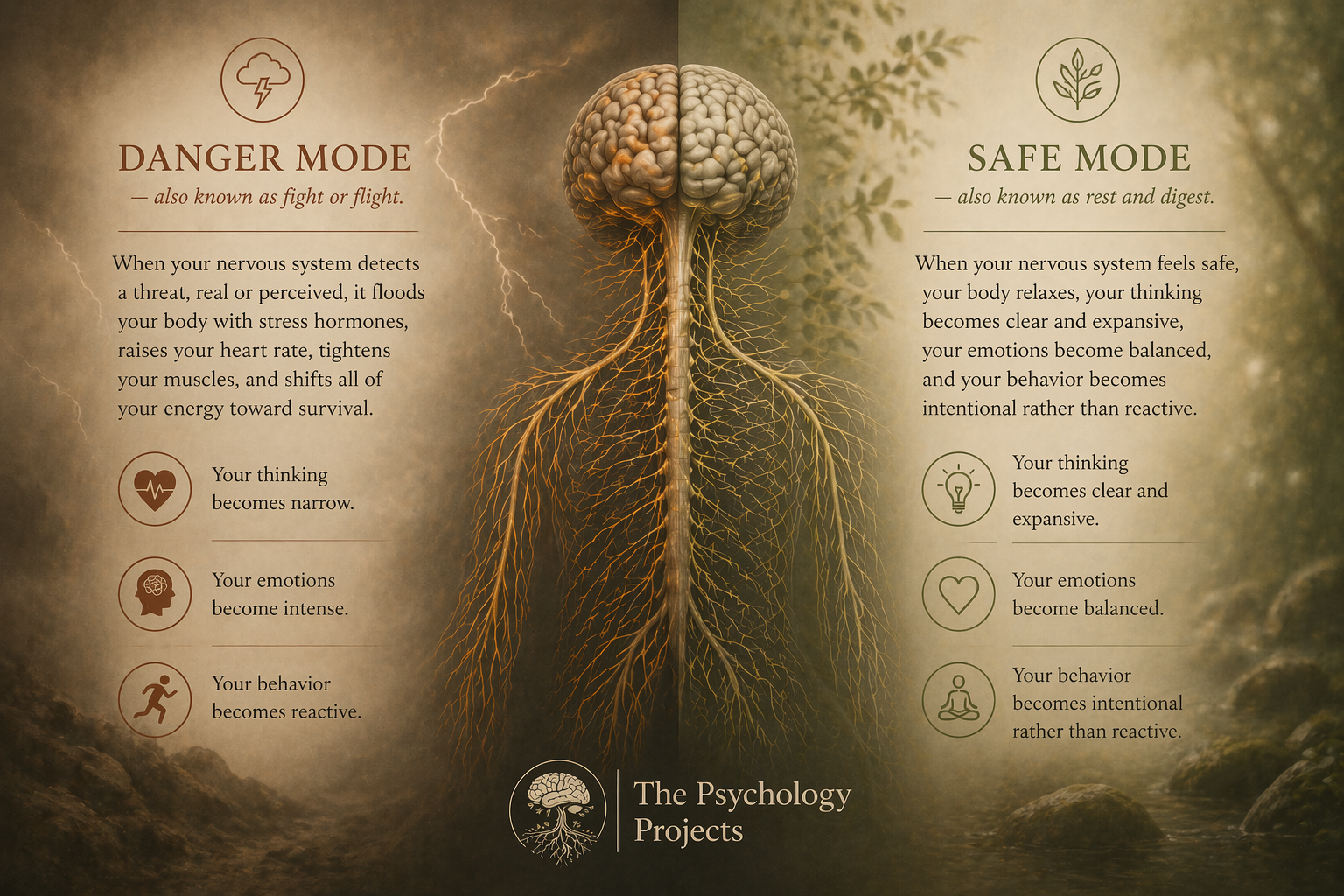
Danger Mode — also known as fight or flight. When your nervous system detects a threat, real or perceived, it floods your body with stress hormones, raises your heart rate, tightens your muscles, and shifts all of your energy toward survival. Your thinking becomes narrow. Your emotions become intense. Your behavior becomes reactive.
Safe Mode — also known as rest and digest. When your nervous system feels safe, your body relaxes, your thinking becomes clear and expansive, your emotions become balanced, and your behavior becomes intentional rather than reactive.
Here is what makes this so important for psychology: most people are walking around stuck in danger mode without knowing it. Not because there is a lion chasing them, but because their nervous system was shaped by past experiences to treat everyday life as a threat.
Your Nervous System Does Not Know the Difference Between Real and Imagined
This is one of the most important things you will ever learn about yourself.
Your nervous system cannot tell the difference between something that is actually happening and something you are vividly thinking about or remembering. A physical threat and a stressful memory can produce the exact same response in your body.
This is why one of the most common things people say — to therapists, in research, in their own private thoughts — is: "Why am I feeling this? I don't even understand why I feel this way."
And the answer is this — emotions are not always responding to what is happening right now. Sometimes they are responding to what your nervous system has already experienced.
Think of it this way. If you burned your hand on a stove, and then months later you reach near that same stove, your body already knows. It remembers the pain before your mind even catches up. You pull back. You tense up. The memory lives in your body, not just your mind.
Now imagine that same principle, but applied to emotional pain. Pain that is far more complex than a burn. Pain that shaped who you are, trauma.
One of my clients sat across from me and said, "I promised myself I would never be back here again. I can't believe this is happening."
But here is what was really happening. He was not back in the same situation. He was in a new situation that his nervous system recognized as feeling the same. A similar dynamic. A similar feeling of powerlessness. A similar emotional signature to something that had happened to him as a teenager. And in that split second, without his permission, his nervous system went back to what it already knew. Back to the emotion it had already stored. Back to the response it had already learned.
His nervous system was not broken. It was doing exactly what it was designed to do — protect him based on what it remembered.
This is why certain places, certain smells, certain tones of voice, certain moments can trigger a reaction that feels completely out of proportion to what is actually happening in front of you. You are not overreacting. Your nervous system is reaching back into its memory and responding to what it already knows.
And until you understand your nervous system, you will keep asking the same question, which researchers document, that people whisper to themselves in their most confused and frustrated moments —
"Why do I keep ending up here? I promised myself I never would."