
Clinical Consultation & Depth Assessment
Advanced Case Conceptualization for Licensed Clinicians & Coaches.
Who is Analytical Consultation for?

You are good at what you do. And you are stuck.
You have a client who keeps returning for sessions, but there's been no progress.
You’ve tried CBT. You’ve tried DBT. You’ve tried everything you were trained to do, and nothing is cracking it.
You suspect misdiagnosis, but you don’t know how to prove it or where to go from here.
Your client’s resistance is running the room, and you don’t know what it’s protecting.
You’re carrying countertransference you can’t shake, and it’s affecting your work.
A therapy rupture happened, and you don’t know how to repair it without losing the client.
Your client is so dependent on you that it’s becoming unsustainable.
You don’t know when to refer out, and you’re holding a case that may be beyond your current capacity.
You are burned out, isolated, and carrying the weight of your caseload completely alone.
You are questioning everything — your competence, your approach, your ability to help.
You don’t need more supervision. You need a Specialist’s X-Ray.
Analytical Consultation Is Not Supervision
Supervision checks ethical boxes. It ensures you are meeting licensing requirements. It tells you what you should do. We are different.
Clinical Case Conceptualization at The Psychology Projects is a structural analysis of why your case isn’t moving. We don’t review your notes. We don’t confirm you’re following protocol. We go into the architecture of the client — their defense structure, their trauma chronology, the unconscious dynamics that are keeping both of you stuck.
Supervision asks, “Are you doing it right?”
We ask, “What is actually happening inside the architecture of the client’s inner world. What is the psyche searching for? What is driving the resistance? We research the root of the problem. We analyze the depth of it. We find the road to consciousness. We find the road to clarity.”
You won't be leaving with a checklist. You will leave with a roadmap.
Beyond Attachment Theory & Behavioral Frameworks

When a case reaches a plateau, it is often because the treatment is targeting the symptoms rather than the Defense Architecture. At The Psychology Projects, we provide licensed therapists and professional coaches with the analytical tools to navigate "gnarly" diagnoses and complex personality structures.
We help you move beyond standard cognitive interventions to understand the unconscious timing of trauma, the specific mechanics of your client’s defenses, and how to build the clinical capacity required for true transformation.
Areas of Clinical Expertise

Complex case conceptualization where standard interventions have plateaued.
Misdiagnosis, identifying what is actually driving the presentation beneath the label.
Resistant clients, understanding the function and structure of the resistance, not just managing it.
Countertransference, identifying how your own history and unresolved material are showing up in the room.
Therapy ruptures: How to repair the therapeutic relationship without losing the client.
Overly dependent clients, building the client’s capacity to separate and carry the work independently.
Secondary trauma and compassion fatigue, the weight you are carrying that nobody sees.
Imposter syndrome that persistent feeling that you don’t quite qualify, that you’re getting it wrong, that something isn’t adding up.
Therapist burnout, when the work you chose is becoming the thing draining you.
Not knowing when to refer out, understanding when a case has exceeded your current capacity, and what to do about it.

Phase 1
Structural Intake & Defense Mapping
We begin with an exhaustive review of the case. I use a specialized analytical assessment to gather the history, the patterns, and the "gnarly" dynamics that are stalling progress. We don't just look at symptoms; we look at the personality structure holding them in place.
Phase 2
The Depth Assessment & Inquiry
Between meetings, I develop a comprehensive Depth Assessment. I provide you with a specific set of analytical questions to take back to your client. These aren't "behavioral markers"—they are keys to unlocking the trauma's unconscious timing and weight. We focus on how the client’s defenses operate in real time.
Phase 3
Synthesis & Clinical Education
We conclude with a complete, depth-oriented treatment plan. I educate you on your client's specific personality structure and how to pace the work. You will leave with a clear understanding of how to build your client's capacity to tolerate their internal world, allowing you to move through the resistance rather than fighting it.

WHAT SETS US APART

We don't aim to remove your defenses; we analyze the architecture that necessitated them. True capacity isn't built by stripping away your survival tools—it’s built by understanding the timing and depth of the trauma they were designed to protect.
Clinical stagnation isn't a lack of technique; it’s a collision with the client’s capacity. We move beyond attachment theory to build the internal structural strength required to face the pain, not just manage the anxiety.
Therapist Reviews
Private practice can feel incredibly isolating, especially when you’re holding complex cases with no space to think them through honestly. It wasn’t just support — it was structured, intelligent reflection that helped me organize my thinking and feel grounded again. I left feeling less alone and far more confident in how I was approaching my work.”
— Licensed Therapist, Private Practice
“There was a case that kept pulling something out of me that I couldn’t fully explain. Through this process I was able to clearly see how my own unresolved material was entering the room and shaping the dynamic. It wasn’t uncomfortable the way I expected — it was clarifying. That awareness shifted not only that case but how I show up across my entire work.”
— Licensed Clinician
“I had been working with a client for months and nothing was shifting. Through consultation I was able to see the underlying pattern I had completely overlooked — and it changed everything. It wasn’t about new interventions. It was about understanding what was actually driving the repetition. Once I saw it, the work started to move almost immediately. That level of clarity is rare.”
— Licensed Therapist

Before You Begin
-
This is consultation — not supervision. Supervision is designed to ensure you are meeting ethical and licensing standards. Clinical Case Conceptualization at The Psychology Projects is designed to go deeper than that. We are not here to oversee your work. We are here to analyze the structural dynamics of your case and provide a roadmap to move it forward.
-
This is for licensed therapists, marriage and family therapists, clinical social workers, psychologists, and professional coaches who are working with complex cases and need a depth-oriented analytical perspective. Whether you are stuck on one case or seeking ongoing consultation support, this is for the clinician who knows something deeper needs to happen and doesn’t know how to get there alone.
-
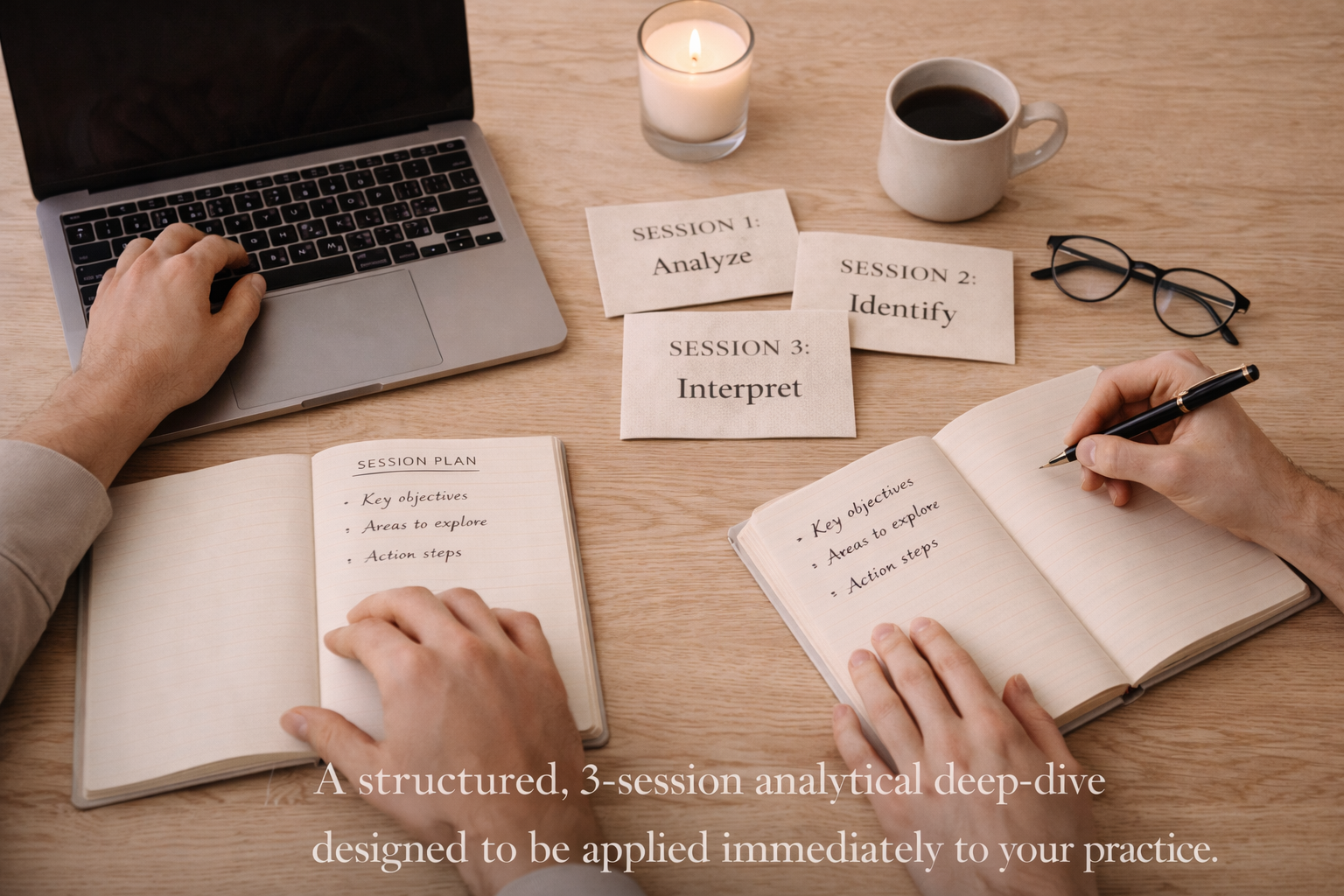
The core engagement is a structured three-phase process spanning three sessions. Each phase builds on the last — from structural intake and defense mapping to depth assessment to a complete treatment roadmap. Some clinicians choose to continue beyond the three phases for ongoing support as the case develops.
-
Consultation fees are structured based on the complexity and scope of the case. Please reach out directly to discuss rates and availability. We believe the right clinician will find a way to make this work.
-
Yes. Consultation is available virtually nationwide — not limited to California residents. If you are a licensed clinician or coach anywhere in the United States, you can access this service.
-
We focus on one case at a time. This is intentional.
There is so much to understand within a single case — the defense structure, the trauma chronology, the unconscious dynamics, the therapist’s own countertransference — that spreading across multiple cases would dilute the depth of the work.
When you go deep on one case, you don’t just unlock that client. You build analytical capacity that you carry into every case that follows.
We are not going everywhere. We are going deep. And depth is where the change happens.
How Analytical Consultation different from other consultation services?
Most clinical consultation is a group setting where therapists present cases to peers and receive general feedback based on standard frameworks — CBT, DBT, attachment theory. It is collegial, supportive, and collaborative. And it has limits.
At The Psychology Projects, consultation is not a group discussion. It is a structured, individual, three-phase analytical engagement. We do not offer general feedback or technique suggestions. We conduct a full structural analysis of the case — the defense architecture, the trauma chronology, the unconscious dynamics holding the stagnation in place.
Where standard consultation asks “what should you try next,” we ask “what is the psyche of this client actually structured around — and what does it require to move?”
This is not peer support. This is a Specialist’s X-Ray for your most complex cases.
Frequently Asked Questions
-
Yes. This is exactly what Clinical Case Conceptualization at The Psychology Projects was built for. When a case has plateaued — when the client keeps coming back with no real movement despite years of work — it is almost always because the treatment has been targeting the symptoms rather than the structure holding them in place. We go into the defense architecture, the trauma chronology, and the unconscious dynamics that standard approaches were never designed to reach.
-
Misdiagnosis is one of the most common reasons cases stagnate. When a client is treated for the wrong thing, nothing moves — no matter how skilled the therapist. We approach this by going beneath the label entirely. Instead of starting with the diagnosis, we start with the structure — what is actually driving the presentation, what the defenses are protecting, and what the personality structure requires. In many cases, what looks like one diagnosis is actually something entirely different operating underneath it.
-
Then you are in exactly the right place. Countertransference is not a flaw — it is data. But unexamined countertransference becomes the invisible ceiling on your clinical work. In our consultation process, we address not just the client’s structure but the therapist’s own internal responses to the case. What is being activated in you, where it comes from, and how to use it as clinical information rather than let it run the session without your awareness.
-
Peer consultation is collegial and supportive. Therapists share cases, offer perspectives, and provide general feedback based on shared frameworks. It is valuable — and it has limits. What we offer is not a peer conversation. It is a structured, analytical deep dive into the specific architecture of your case. We are not giving you another opinion. We are giving you a structural map of what is happening inside the client and a roadmap for how to move it.
-
Yes. In fact early career clinicians often benefit most from this work. The analytical foundation built through one well-understood case changes how you approach every case after it. Whether you are newly licensed and navigating your first complex case or a seasoned clinician who has hit a wall — if you are ready to go deeper, this is for you.
-
Yes. Burnout in clinicians is rarely just about workload. It is almost always about carrying the weight of cases you don’t fully understand, in isolation, without the analytical tools to move them. When cases stagnate, when clients don’t progress, when you sit with the same stuck feeling session after session — that is what burns therapists out. The work we do here does not just help your client. It rebuilds your clinical confidence and your relationship with the work itself.