Why the Highest IQ in the Room Couldn't Save Its Own Trauma
Summary
As a Licensed Marriage and Family Therapist (LMFT) specializing in trauma and high-achieving professionals, I'm often asked why intelligent, successful people remain stuck despite years of self-awareness and hard work. The answer lies in a fundamental misunderstanding of what trauma actually is. Trauma is not the painful event itself — it is the unprocessed physiological residue left behind when your nervous system lacks the capacity to complete the stress response cycle. Intelligence, insight, and willpower operate through the prefrontal cortex. Trauma lives in the body, the unconscious, and the sympathetic nervous system — systems that do not respond to reasoning. This article explains the clinical mechanism of trauma, why high achievers are particularly vulnerable to its hidden costs, and what it actually means to process an experience at the nervous system level.
Your intellect is a fantastic tool for solving problems and making money. It is a terrible tool for feeling them.
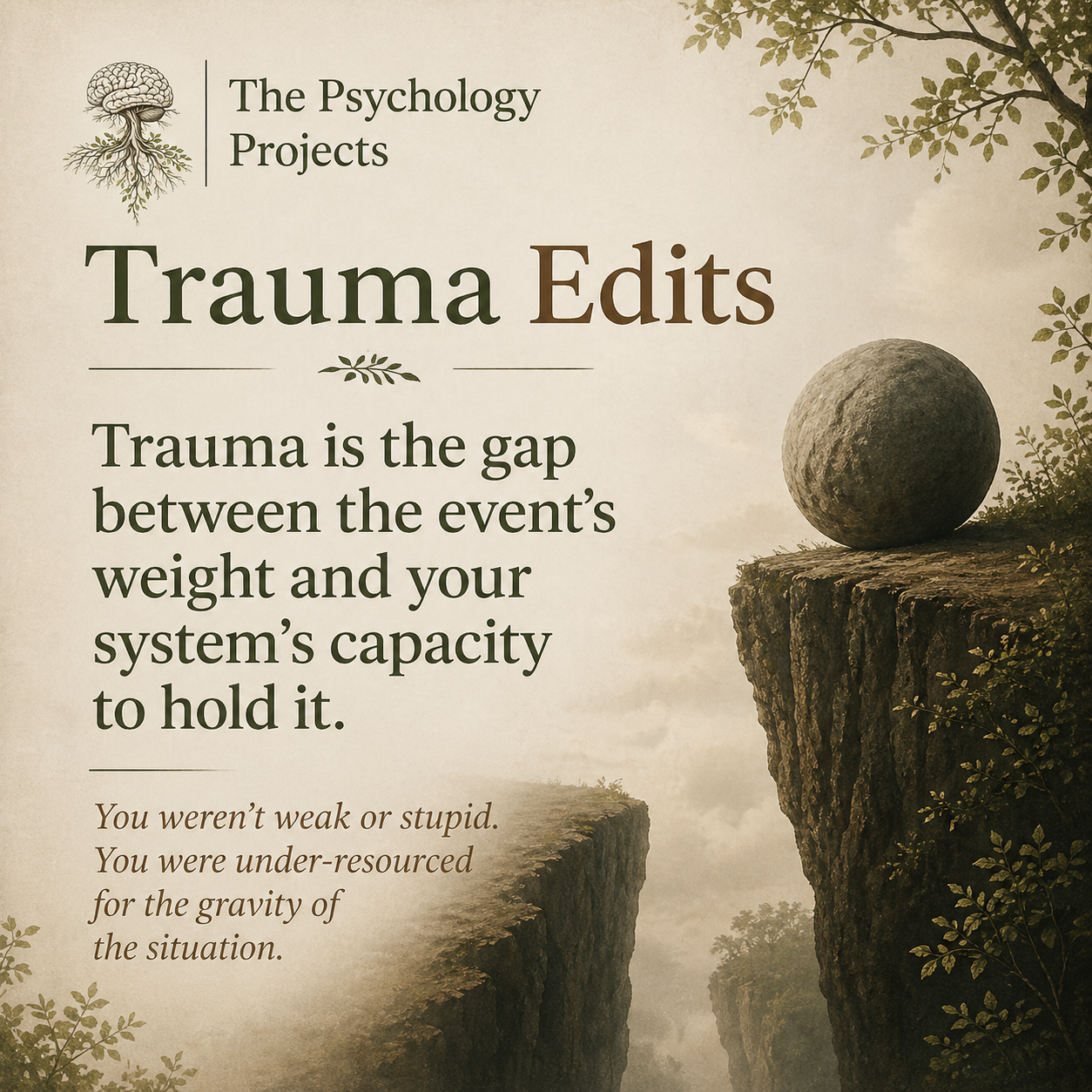
THE HELICOPTER PILOT
Imagine you are an elite helicopter pilot — the best in the world. Suddenly, an unpredictable storm hits, wild, unpredictable, loud, uncontrollable, and unseen. You’ve trained to be the best — but this is beyond what training was ever built to handle. It is a natural disaster of such magnitude that it exceeds the aircraft's weight capacity. Does your intelligence or training matter? Do your 20 years of elite experience matter? NO. The helicopter doesn’t have the capacity or the space to land.
Trauma is what happens to that pilot after the storm. It is the gap between the event's weight and your system's (the helicopter's) capacity to hold it. You weren't weak or stupid. You were under-resourced for the gravity of the situation.
You cannot think your way out of a physiological state. You can't debate your nervous system into feeling safe any more than you can talk your stomach into digesting a meal faster. Just the same way, this helicopter pilot, with all of his experience and skill, cannot fight against a storm whose magnitude exceeds his capacity.
THE EVENT IS NOT THE TRAUMA
Most people think trauma is the event. It is not. The event is the trigger, and we constantly mistake the trigger for the trauma itself.
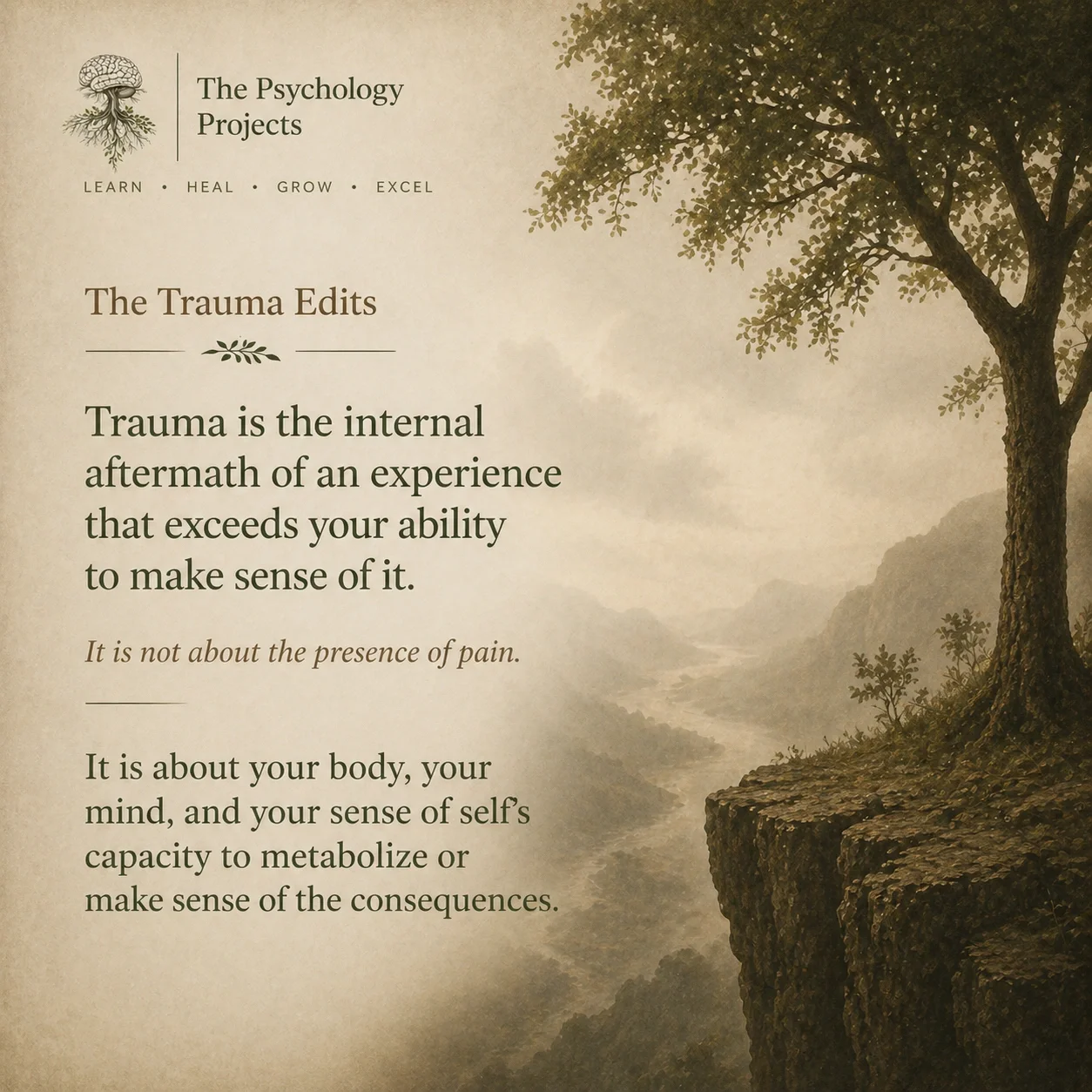
Trauma is the internal aftermath of an experience that exceeds your ability to make sense of it. It is not about the presence of pain. It is about your body, your mind, and your sense of self's capacity to metabolize or make sense of the consequences.
To metabolize trauma means to complete the stress response cycle. Just as your body must break down food to gain nutrients and discard waste, your nervous system must "digest" an experience. If you cannot process the high-voltage energy of a threat, it doesn't leave. It gets stuck in your tissues and your psyche.
When you cannot metabolize an experience, it leaves traces in the body and, most importantly, the unconscious mind. We think that because we have "forgotten" or "moved on" from the incident. But if we haven't found a way to make sense of the trauma, it stays active in the background like a program you never closed.
TRAUMA IS WHAT HAPPENS INSIDE YOU
Prior to the storm, you were a happy, successful pilot. Great records. A beautiful day in the air. You were in a state of safety. You believed the ground was solid. Then the storm hit, contradicting everything you knew about safety and security. Trauma begins in the gap between what you believed was true — safety — and what your nervous system suddenly couldn't deny — danger.
And sometimes, that “storm” doesn’t look dramatic at all. It looks like a fourteen-year-old being rejected, humiliated, or bullied by the very people he trusted. Something small on the outside for an adult — but at that age, it carries the same contradiction: what once felt safe no longer is.
Click here to learn about the CEO of your nervous system
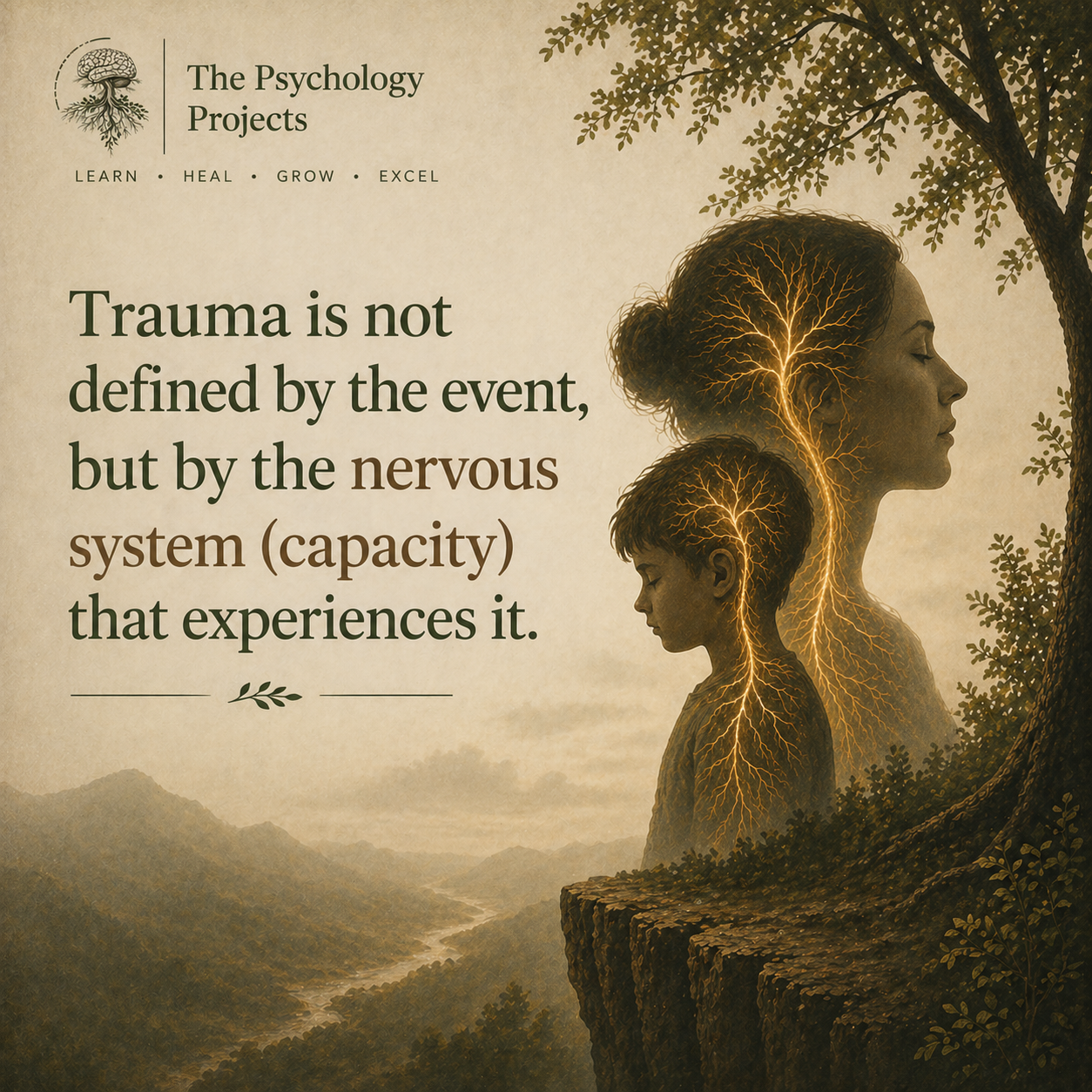
Trauma is not defined by the event itself, but by the nervous system (capacity) that experiences it. And that capacity changes across development. What overwhelms a fourteen-year-old is not the same as what overwhelms an adult — not because one is weaker, but because their internal architecture is still forming. The younger the system, the less capacity it has to make sense of contradictions, rejections, or fears. What looks small to an adult can be destabilizing to a developing mind.
Regardless of age or gender, trauma doesn’t go away — it stays in the system until it is processed. And unfortunately, we live in a culture where “moving on” is mistaken for strength, while the unresolved experience continues to live underneath it.
Think about a computer. You have a program running in the background that you aren't aware of. You're still functioning — checking social media, answering emails — but that program is quietly draining your memory and energy.
This is how trauma gets stuck in the system — the original rupture gets translated into “moving on,” while the pain, uncertainty, and unresolved experience continue to run in the background. You "forget" it's there, but it's draining your cognitive and emotional resources. Because we don't look for the hidden program, we end up with unconscious reactions and behaviors that don't make sense to us. Here’s a list of problems: depression, anxiety, feeling stuck, self-sabotage, procrastination, ADHD, autoimmune disorders, and frequent misdiagnosis.
PROCESSED VS. UNPROCESSED
There is a visceral difference between an experience that has moved through you and one that is still alive.
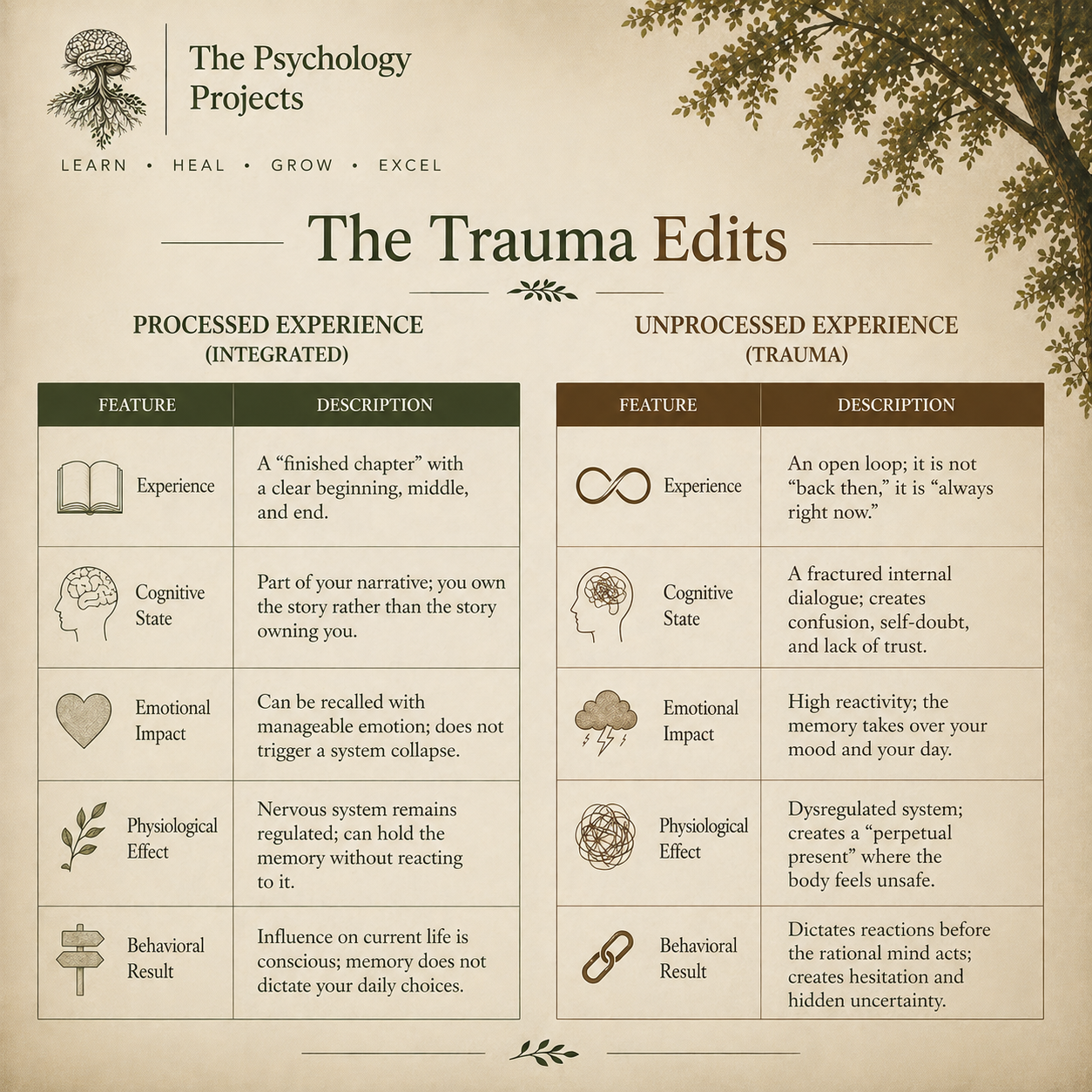
Unprocessed trauma has a different story — it's split.
Processed experience becomes part of your narrative — a story you tell. You see it in people all the time. One person can talk about being bullied at fourteen and laugh about it — it has a place in their story. Another avoids the subject entirely, hesitates, or becomes subtly defensive. The difference is not the event. It’s whether the experience was processed or not.
Furthermore, you get into a car accident. You take the time to breathe through it, to name the fear, to make sense of the shock. Years later, thinking about it might still bring up a sting of pain, but it does not collapse your system. It has a beginning, a middle, and an end. You can hold the memory without it taking over your behavior, your mood, or your day. It is a finished chapter.
Unprocessed trauma has a different story — it's split.
One part says, "I am not safe." I need to run. The other asks: Why am I not good enough? Why can't I get out of this mud? I have the talents, I have the skills — why am I not doing enough?
And because neither part can finish its sentence, the experience has no place to land. It creates a perpetual present — a state where you know what you need to do, but a force within hesitates. Where your life looks fine on the outside, but internally, there is a quiet uncertainty you can’t fully explain. Where trust — in yourself or others — doesn’t come naturally, even when it should. For the traumatized system, it isn't "back then." It is always right now. It doesn't just sit there — it dictates your reactions before your rational mind even wakes up. It isn't a story you tell. It is a force that tells you how to behave.
TRAUMA IS NOT THE PAIN
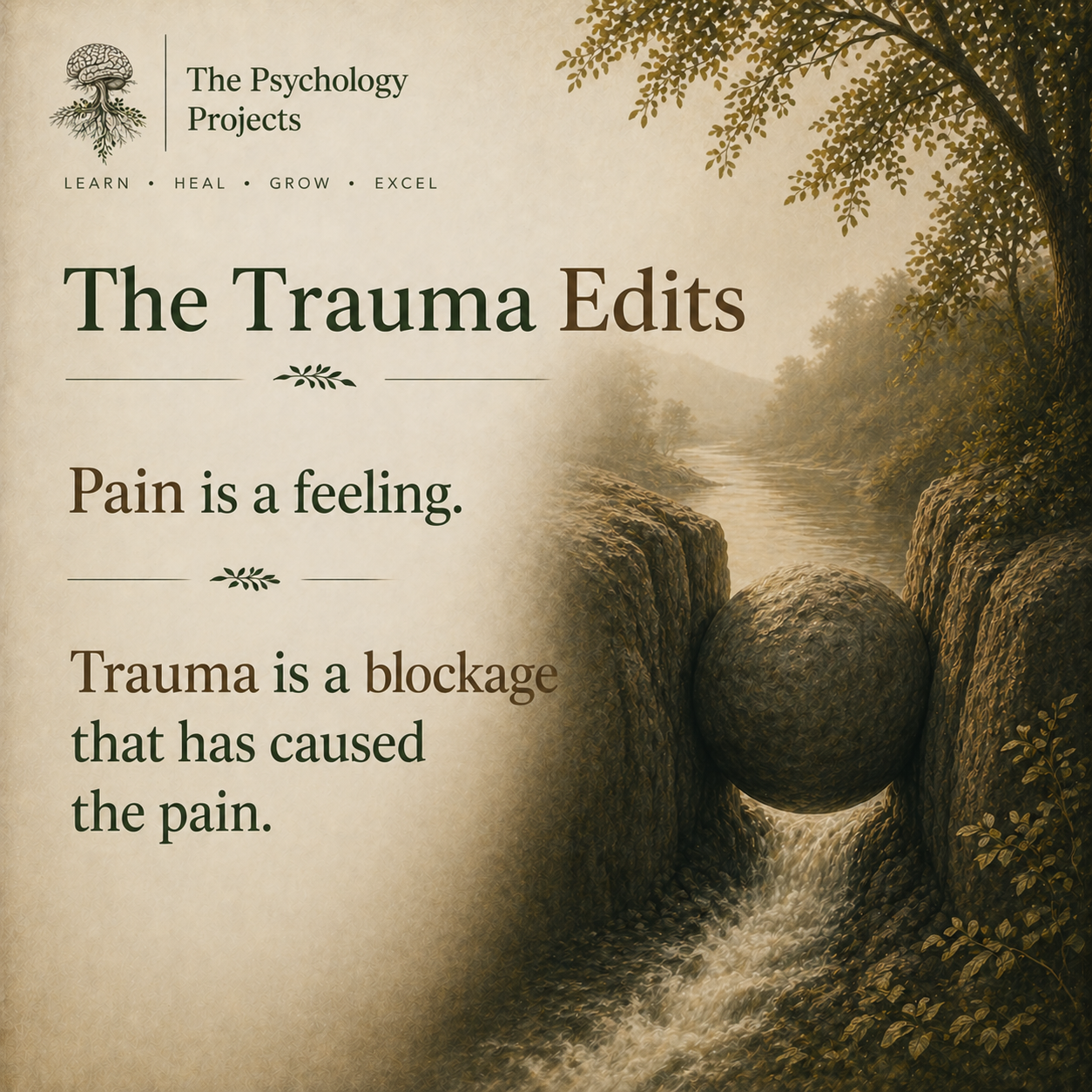
Pain is a feeling (sadness, excitement, fear, hate, etc.). Trauma is a blockage that has caused the pain. Many people have survived devastating pain and not been traumatized. Because they had the safety to feel it, the space to fall apart, and the support to integrate it. Many lacked the support and the capacity, and they are blaming themselves for being human.
The problem is that we live in a society of instant gratification. We are constantly told to "let it go," so we mistake distraction for moving forward. High achievers are masters of this — as soon as they feel a little bit better, they pour themselves back into intellectualizing the story, the busy work schedule, committing to new projects, productivity, and pushing harder.
Externally, you have moved on. But internally, that background tab is still running. You think you have consciously forgotten about the incident, but your psyche is running in the background.
This is where psychology needs to adopt a modern, updated approach to help people excel. Because when the crisis is not integrated into our life's narration (the conscious mind), the pain, the trauma, the loss, the damage is rooted and running in the unconscious mind, and it starts to leak out as symptoms — depression, anxiety, a constant sense of dread while your mind says my life is fine. Clinicians see the symptoms. Nobody looks for the hidden program underneath them.

You have moved forward, and your feeling of uncertainty and the behaviors that don't make sense don't lack intelligence. You are running a more expensive version of your pain.
Masti Lashkari, LMFT | Licensed in California | License No. 136681 | NPI: 1961182265 Mastaneh (Masti) Lashkari is a Licensed Marriage and Family Therapist based in Newport Beach, California, and the founder of The Capacity Method, specializing in trauma, nervous system regulation, and high-achieving professionals. The Trauma Edits is a clinical content series translating evidence-based psychological concepts for an educated general audience.
